
When I searched my name, “JP Espinoza,” across Google, Bing, and Yahoo, the story was clear: I am strongly defined by my professional role as Managing Partner with New York Life in New Mexico. The first several links and profiles tie directly to the company, my office location, and professional directories. For someone seeking financial services, I am easy to find, and my credibility is reinforced by the Fortune 100 brand I represent.

But this visibility comes with limits. My online presence is narrowly framed through the corporate lens. The narrative is dominated by my role at New York Life and not by the broader story of who I am — an entrepreneur, a student, a strategist, and someone building a legacy. This realization forces me to ask a bigger question, and it is the essence of the digital dilemma: how do I create a personal brand when the corporate brand dominates the conversation?
The tension is especially sharp in financial services. Unlike peers in unregulated industries, my digital presence is constrained by compliance rules. Under FINRA regulations, how I present myself online is monitored and restricted to ensure I do not mislead or overpromise. This means every post, article, and profile carries boundaries that professionals in other industries may not face. For many, the “safe” approach is to let the corporate brand do the heavy lifting — to accept being defined by the company name and leave it at that.
Yet, the modern marketplace demands more. Today, clients, peers, and future partners don’t just want to know what you do — they want to know who you are. They want to see your values, your journey, and your unique vision. If my online story is told only through New York Life, it leaves out my entrepreneurial ventures, my academic path, and my mission of building generational wealth for families. It leaves out the essence of JP Espinoza.
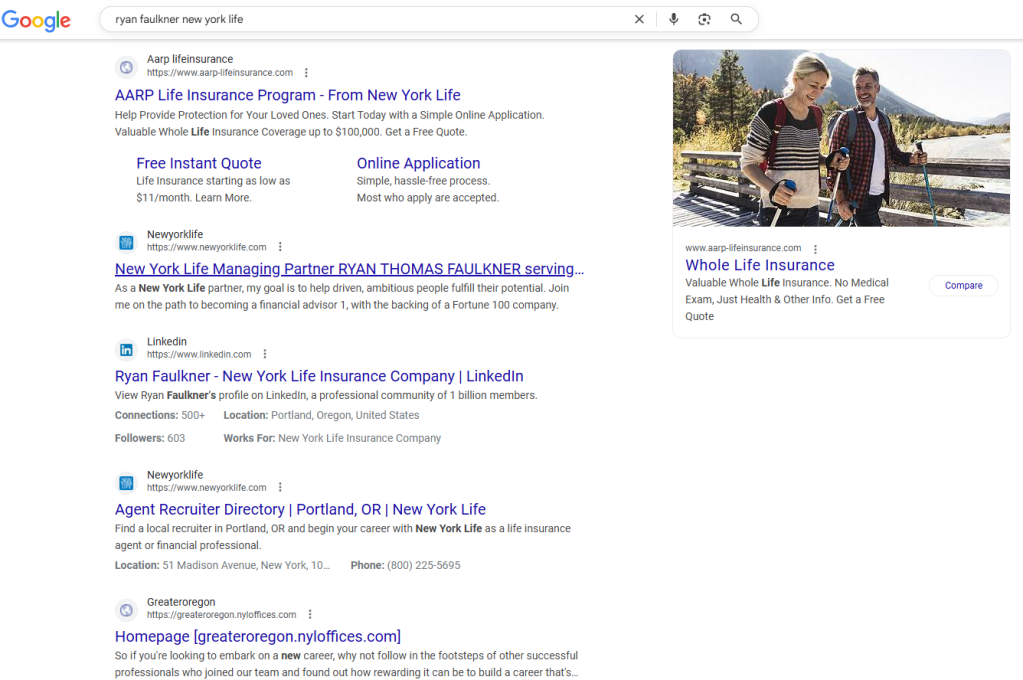
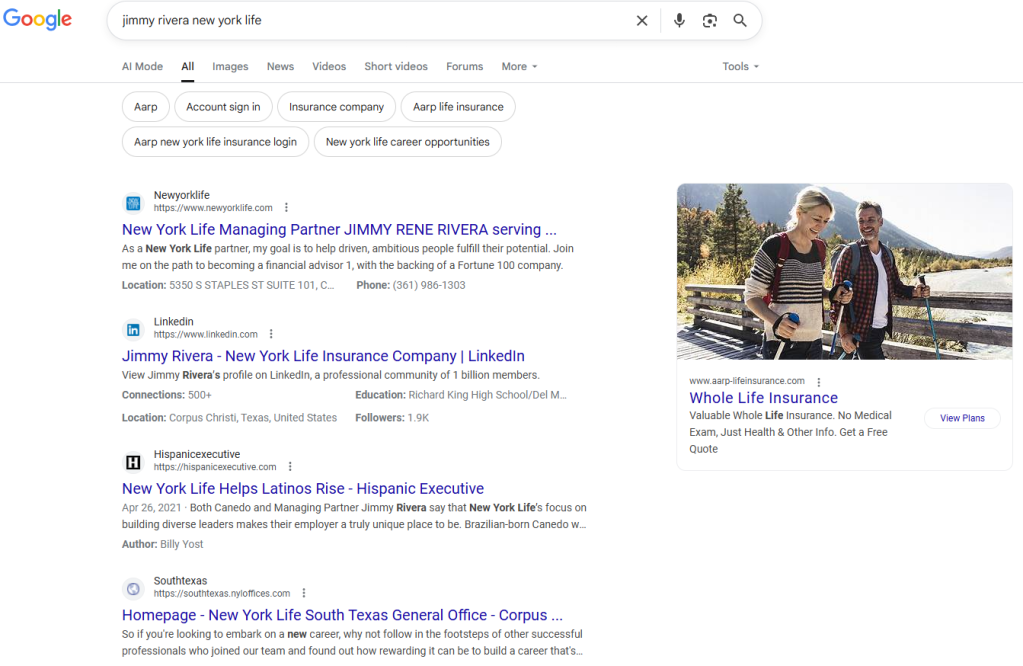
When I compared myself to peers like Ryan Faulkner and Jimmy Rivera, I found similarities. Their search results are also dominated by New York Life branding, LinkedIn, and local directories. However, Jimmy Rivera’s online presence includes interviews and features that reveal more of his personal leadership philosophy and community engagement. That subtle difference makes his digital presence feel more human, not just corporate. It made me realize that compliance does not have to mean invisibility — it simply means creativity is required.
And that is the heart of The Digital Dilemma: Corporate Identity vs. Personal Legacy. The challenge is not whether we can brand ourselves — it is how we do it. The innovative question becomes: how do we tell our story, within compliance, in a way that adds dimension beyond the company we represent? How do we highlight the entrepreneurial side of our journey, the values that drive us, and the legacy we are building?

 Rain Maker Nation